The Quest for Certainty
Is an objective understanding of ethics possible?

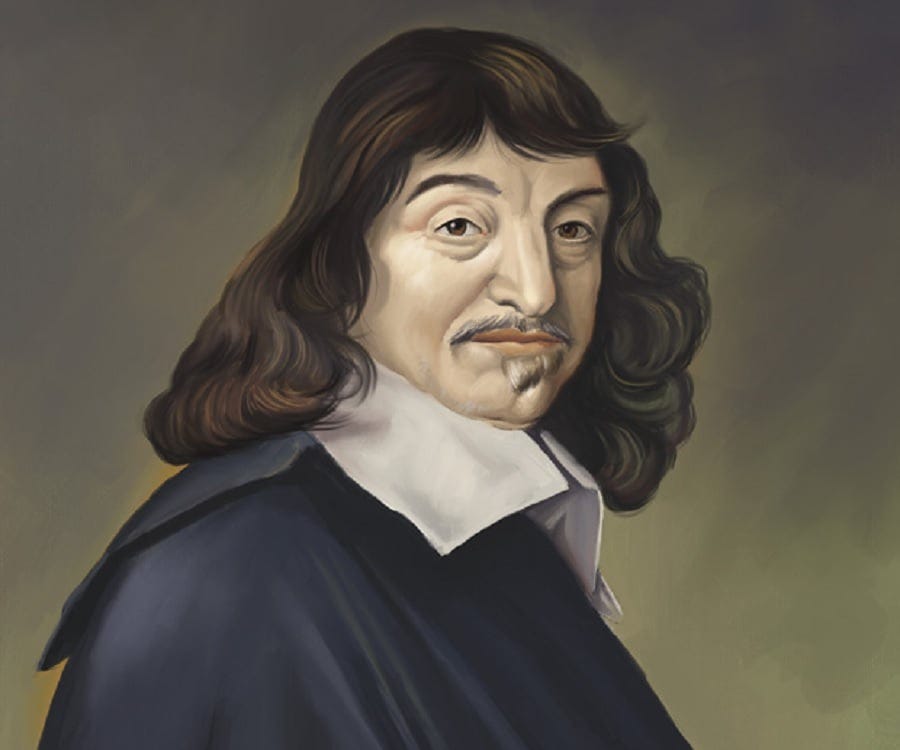
Descartes
I began in my last post with a question: Is ethics meaningless? I felt that was the best place to begin with an exploration of morality because it’s the very bottom point in ethics. And we hit that point in the first part of the 20th century. It was a doctrine called Emotivism. That’s also where the modern world and our new the Enlightenment mindset was in many respects directing our thinking since Descartes helped kick off the Enlightenment—the modern age—back in the 17th century.
It is quite understandable that Descartes would develop a passion for certainty. It’s difficult for us to comprehend the psychological upheaval which began merely a century before Descartes’ time by the Protestant Reformation. This shattered the spiritual authority in Europe. With no final authority the West was plunged into uncertainty about basic beliefs. Religious wars were fought on and off right through Descartes’ most productive philosophical writing. The West was hungry for a sense of certainty. The times were ripe for a way to regain it. Descartes was one of the first but merely one of several over the next century tapping their way toward this elusive goal. And even now we are haunted by a desire for certainty that seems to elude us.
Let’s look at how Descartes kicked off his quest for certainty. As anyone who took an introductory philosophy class should know Descartes began with doubt—extreme doubt. In fact, he began by doubting everything. This is where we find Descartes’ famous phrase “Cogito ergo sum” or I think therefore I am. That is, Descartes doubted everything until he got down to the fact that he was thinking and, obviously, he could not doubt that. The fact that he was thinking was where he would begin to build back certain knowledge. So Descartes method of doubt, his skepticism, became an important part of his foundation for certain knowledge.
One of Descartes earliest statements of his method is as follows:
“We should be concerned only with those objects regarding which our minds seem capable of obtaining certain and indubitable knowledge with a certainty equal to that of the demonstrations of arithmetic and geometry.
“[W]e reject all knowledge which is merely probable and judge that only those things should be believed which are perfectly known and about which we can have no doubts.” René Descartes, Regulae, (Rules for the Direction of the Mind.)
In summary, Descartes quest was to find indubitable truths as a firm foundation for knowledge. As the so-called father of modern philosophy we inherited that skeptical approach.
We saw in a previous post that modern thought eventually tapped it’s way by the early 20th century to Emotivism, the belief that ethics is meaningless. A. J. Ayer’s emotivism was then refined by an American, C. L. Stevenson. It then got further refined by various philosophers into an ethical theory called Expressivism. Nevertheless at bottom it remained an argument that moral statements are merely statements about mental states.
In that earlier post I talked about what I called an Enlightenment mindset. Basically I mean a set of background assumptions that we inherited from the beginning of the modern age and specifically from the father of modernity, René Descartes himself.
Our Enlightenment mindset left us burdened with an obsession with epistemology—a concern with how we can know anything. Knowledge became the main issue of philosophy. That meant we had to deal with the problem of skepticism. However, beginning in about the middle of the twentieth century—about the time A.J. Ayer argued that ethics was meaningless—we started to dig ourselves out from this intractable situation.
A Look at Science
At this point I want to take a few steps to a different way of thinking about ethics. However, I’m not breaking new ground here. In the second half of the twentieth century a few philosophers have started down versions of this same path. I want to begin in what may seem an odd way—by talking about science.
With the growth, and success, of science since Descartes first articulated his skeptical attack on knowledge, the modern age learned over time that there was no one so-called scientific method. There are, in fact, multiple methods of science to accompany the multiple sciences that grew up in the modern age.
But something more important began to change with the growth of scientific knowledge. It was discovered that Descartes’ level of skepticism would have to undergo a change in order to match how the scientific enterprise was actually conducted. Outside science—in areas like ethics—Descartes’ level of skepticism more or less prevailed. As we’ve seen, this contributed to a drift to emotivism. Ironically part of the emotivist argument rested on a claim that ethics was unscientific even though the actual scientific enterprise itself was evolving.
Obviously I’m using the evolution of science here as an analogy to how we might begin to think about ethics. This brings us to a somewhat complex issue. We are situated. By that I mean that our knowledge of the world is always from a point of view—a point of view that is limited. That fact at first appears to amount to a barrier between us and a clear understanding of objective reality. That fact is also what fuels modern skepticism. Is modern skepticism correct? Can we arrive at some understanding of objectivity from our limited perspective? Or are we doomed to exist in a world of moral subjectivism and relativity? Let’s continue our look into the history of science for a glimpse of an answer.
In our modern age science has discovered that there are many truths about the physical world. But we know and we accept that there is not just one overall truth. Science has not found—and nowadays generally does not seek—an overall explanatory scheme for the physical world.
So how does science comprehend the truth about an objective reality? Truth for scientists is now understood as reasonable and probable explanations of the physical world, nothing more. But also note, it is truth as reasonable and probable explanations in astrophysics, biology, neuroscience and so on.
Any scientific explanation is also assumed to be limited and conditional. Today a good scientist remains open minded with well-developed practices of searching for evidence to falsify accepted theories while also searching for competing theories to be tested. This is hardly the position envisioned by René Descartes in the seventeenth century of a “certain and indubitable” truth. That high level of certainty for truth was Descartes goal. But science moved away from that goal.
More than abandoning a search for an overall scheme of truth, we now accept that we can never know with certainty that we have attained the whole truth even in any specific scientific endeavor. Any explanatory theory may have some errors or be incomplete in some important respect. The transition from Isaac Newton’s physics to Albert Einstein’s physics is always cited as the classic example here. Years of experience has taught us to willingly accept that possibility which is now firmly ensconced within our various scientific methods. In a way one could argue that the mind-boggling advances of modern science are the best rebuttal to the method of skepticism and quest for absolute certainty advocated by René Descartes.
Why do I say all this? My point here is simple. We should be reluctant to set the bar for objective truth in ethics any higher than the bar we set for objective truth in science. Truth in ethics does not have to rise to the Cartesian level of “certain and indubitable” truth. It only needs to be reasonable and probable. Nor do we need to have an overall comprehensive scheme of value or the good in order to comprehend some of it. We need not start with indubitable truths as a foundation. Ignoring such a foundation would also mean, like any good scientist, we remain open minded—searching for ways to test alternative ethical theories. And, most importantly, that we accept that we can never know with certainty that we have attained the whole truth but, again like any good scientist, remain willing to accept reasonable and probable explanations as at least part of the truth. I submit that this is a workable template to do good ethics—as it is understood for good science.
In our moral life could it be possible that our knowledge can be corrigible and incomplete yet reliably certain? Is it also possible that our knowledge can be from a limited point of view, from a perspective, and yet be objective? It works in science and it should work in understanding our moral life.
As I pointed out in a previous post, it’s a slow process for new ways of looking at the world to take root. And, likewise, it’s a slow process for obsolete concepts to be discarded. For this reason I think many will remain unconvinced by this analogy of ethics to science. They will say that’s the correct view about science. But science is one thing and morality is another. Agreement on reasonable and probable truths in science is one thing, but agreement on reasonable and probable truths in ethics is quite another. Ethics will remain hopelessly bogged down in subjectivism and relativity. The human condition is more complex than physical reality. That may be so. But actually that is not an argument against the analogy. It’s an argument that the task may be more complex.
Finally some will argue that David Hume placed a logical barrier in our path with his famous “is-ought” gap. Hume’s argument, along with G. E. Moore’s naturalistic fallacy doctrine, is accepted as almost unshakable dogma for many in our contemporary way of thinking. Is Hume’s guillotine, as some call it, correct? Is there an ironclad barrier to objective truth in ethics? Is there a way around it? That’s where we need to go next.
So what do you think? Is it too much to ask that truth in ethics should have no greater standard than truth in science?
“We should be reluctant to set the bar for objective truth in ethics any higher than the bar we set for objective truth in science.“
The problem is that if we hold it to the same epistemic standards of science, nothing in ethics seems to be reliable knowledge. For example, what experiment or observations can we make to establish whether safety or freedom are more important? Or where the correct compromise lies between them? Or what objective criteria we can use to test whether gender roles in our society should be strict or flexible?
That isn’t to say we can’t do science to establish what might be the best conditions for particular outcomes, that is, for particular values. But we bring those values in with us. Science can’t establish or refute them, except in relation to yet more values.
Which I think just a recap of the problem Hume identified.
Cheering you on, here. I have a sense from previous discussions that we have some similar views on these matters. It’s nice to see you expanding on them long-form!
Some random thoughts your post inspired…
Skepticism, yes. Along with a mechanistic view of reality as clock-like. And, in contrast to God's will or fate, the idea that we could understand the clock. As you’re writing about, it didn’t take long for us to find a few things maddeningly ineffable: math, morality, consciousness, particles, etc.
I like the contrast between how science is contingent and convergent whereas ethics/morality is viewed as having to be either perfect or relative. I quite agree the former seems a workable model. That model — evolving based on real world feedback — is how our brains learn to be minds.
Your thesis here reminds me of something I’ve often said about topics like climate change or vaccines: Not being able to understand all of it doesn’t mean we can’t understand some of it.